
Food banks in Canada are mostly being used as a routine strategy for coping with high cost of living instead of being an emergency safety net. This high cost goes hand in hand with the causes of food insecurity in Canada. In 2023, about 10 million people (25.5% of the population) in Canadian provinces faced food insecurity. This increase is about 1.3 million from the previous year which records as the third consecutive annual increase.
It’s not hard to determine the causes of these rapid increases. The main causes of food insecurity in Canada are from the rising housing costs, food costs, work hours and low wages. Daily expenses of Canadians are highly affected by the rising living costs, and many are concerned about affording food and housing. Behind the numbers are millions of stories of struggles faced by common Canadian citizens.
As Azim Dahya, Volunteer CEO & Founder of MFBCS says,
| “Every time someone visits a food bank, there’s a story behind it. More often than not, it’s a story of rising costs, tough choices, and a need for support during difficult times.” |
Provincial Food Bank Statistics in Canada
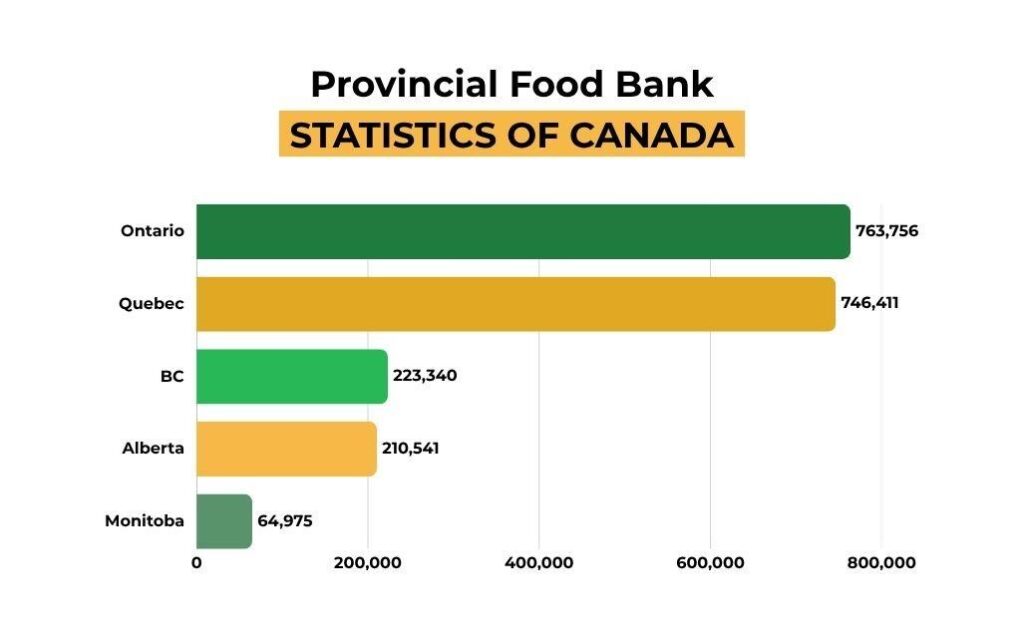
The usage of food banks varies for different areas of Canada. Some areas have a much higher usage than the rest and usually carry high living costs. In March 2025, the demandwas concentrated in large provinces with some of the highest food bank visit volumes being in Ontario and Quebec. Many families who live here struggle to afford basic needs, but we do know that the problem is not limited to one or two areas. It has become a nationwide problem that needs to be taken care of.
Food insecurity is higher in the metropolitan areas because the cost of living is higher compared to other areas. This can also be explained through the affordability stress discussed above. People living in metropolitan areas spend most of their income on expenses like rent, transport, and essential bills. This puts more pressure on low and middle-income households, leaving them with little to no money for food. Financial pressure is what then leads to the rising usage of food banks in metropolitan areas.
Rising Food Bank Usage in Canada: Where the Surge Began and Why it Continues
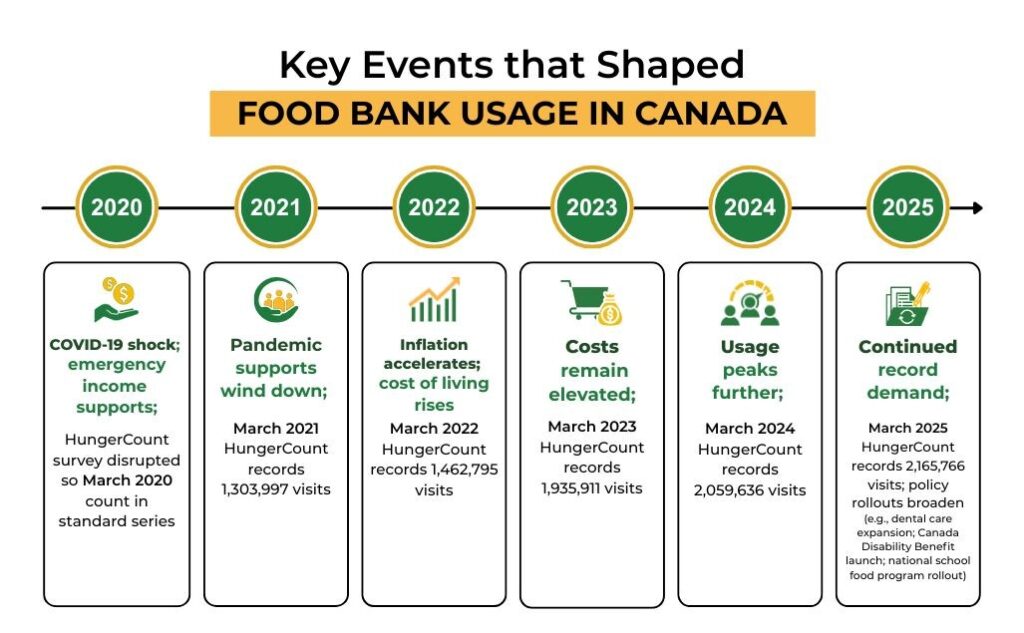
Since the COVID-19 pandemic, food bank usage in Canada has risen sharply. However, even after years of the pandemic ending, their usage hasn’t decreased. There has been a steep hike in monthly visits to food banks year-over-year. In March 2025, 2,165,766 visits were recorded, which is about 5.2% higher than in 2024 (2,059,636), and about double the visits in March 2019.
The primary use of food banks is not because people don’t budget. It is to cover the growing gap between what people earn and what they spend on basic needs like housing, bills, food, childcare, transport and debt. This helps us understand different factors that contribute to the rise in use of food banks in Canada.
Key Events that Shaped Food Bank Usage in Canada
To make it easier to understand, here are the last five years presented in a timeline.
The Rising Cost of Living in Canada
Affordability stress refers to the pressure that people face when their earnings are not enough to pay for their basic needs, like food, rent, transport, bills, etc. The growth in food bank usage is closely related to the rising cost of living which causes affordability stress for people. In Spring 2024, 23% of Canadians reported that they are likely to depend on food banks for meals over the next six months. This percentage increased to 42% among the people having lowest incomes.
Through the years, major shifts have caused the usage to grow rapidly as shown in 2025. 19.4% of the people receiving assistance from food banks reported that their main source of income was employment. This means that the average wage just isn’t enough to cover the rising cost of living in Canada. When money is tight, people often first cut back on food expenses rather than other essentials.
Income, Wages, and Precarious work
The use of food banks among employed people is reaching its highest level, as 19.4% of the clients reported that their main income came from employment. People mainly turn to food banks because housing and food have become too expensive, while many workers still work under low wages and do not get enough hours at work to make ends meet. Increase in the number of such workers indicates that employment income is not enough or reliable to protect against financial hardship.
Housing Costs and the “Rent vs Food” Tradeoff
Rising rental costs of housing are one of the main reasons people depend on food banks. Approximately 70% of clients of the food banks are living in rental housing, showing that their rent often takes most of their income and leaves too little for food.
In Spring 2024, around 38% of Canadians were very worried about the affordability of housing, up from 30% in spring 2022. The food banks usage rises when rent jumps faster than wages, and food becomes one of the most adjustable line items.
Grocery Price Inflation and General Cost of Living Pressure
During Spring 2024, 45% of Canadians showed their concern that the rising costs consistently affect their ability to manage the day-to-day expenses, 12 points higher than the previous two years. When basic costs gradually arise, the households that are slightly above the poverty line will eventually fall into crisis, especially if they have childcare costs, debt, or a sudden loss of income. This pressure majorly contributes to the rise in use of food banks when income is not sufficient to cover the cost of living.
Disability and Health-Related Vulnerability
Another strong risk factor are disabilities that make people vulnerable to food insecurity. 26.4% of people with disability lived in an insecure food household compared with 12.5% of those without a disability. Reports also showed that people with disabilities, while taking other factors into account, are still much more likely to experience difficulty accessing enough food, even with food bank support.
This is important for the food banks because people with disabilities face extra financial pressure, such as medical costs, caregiving needs, and mobility issues, while also dealing with an unstable source of income. Because of this, food insecurity becomes an ongoing problem rather than a one-time emergency.
Immigration, Newcomers, and Eligibility Gaps
Recent reports show that more newcomers are turning into food bank clients. This also points towards an important issue: many people are likely unable to access benefits or government support programs because of uncertain immigration statuses or strict eligibility rules.
Other newcomers face food insecurity in households that have one-parent families or unattached non-seniors. These patterns reflect the realities new immigrants face while settling into a new country.
Muslim Community Needs that Increase Food Bank Usage
Although hunger is not specific to any community or faith, muslim food banks often see more concentrated visits because of certain dynamics and a mix of demographics. The main cause is the cultural and dietary specifications of Muslims.
Food Must Be Halal
For a majority of Muslims, the most important requirement is that the food be ‘halal’. The best option they see for themselves are the muslim food banks, where they can find reliable halal proteins without having to compromise on the nutritional sufficiency for families, especially children. Even non-protein based products can contain ingredients that result in the foods not being halal, like gelatin.
The Use of Food Banks Rise in Ramadan
Another factor that affects the visits is the religious calendar. Food drives are more common in Ramadan than in other months. During Ramadan, the usage of food banks rises due to iftar meals throughout the month. This is because of the strained budgets of many individuals and families that becomes a heavier burden when they need more nutrition-rich content to sustain them while fasting.
Solutions to Address Issues of Rising Food Bank Usage
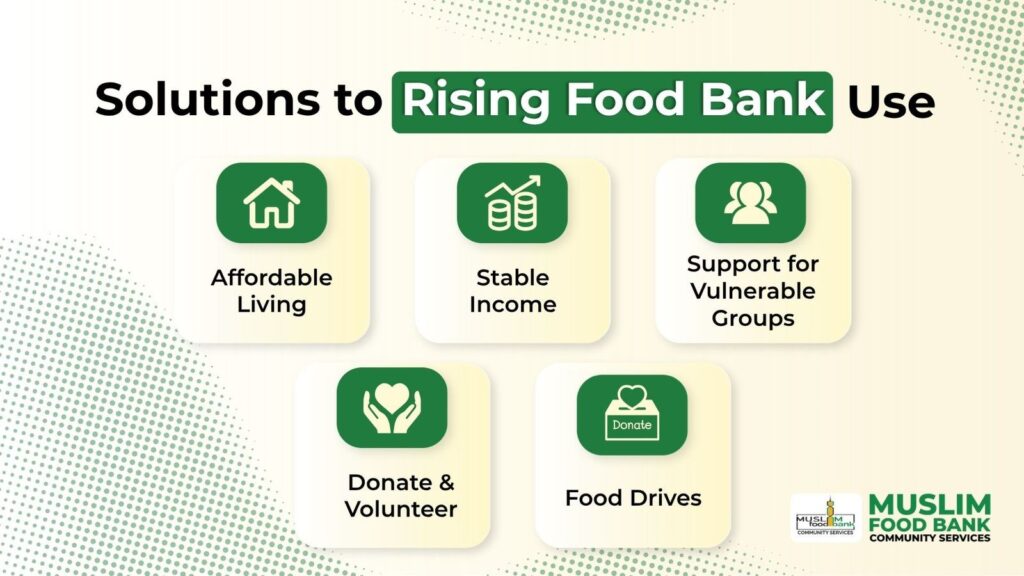
As responsible citizens, we should know how we can solve the problems faced by our society. Along with the following solutions that our government can implement, there are some actions that we can perform as well to better the situation.
1. Reduce Cost of Living
As the cost of living decreases, affordability stress goes down and people need food banks less. This can start by just cutting down on unnecessary expenses, subscriptions, and other items that are just not as crucial. The most important policy response for this crisis is to find opportunities for more affordable housing, groceries, and essential items.
2. Raise and Stabilize Incomes
It would be beneficial to raise the basic salary and improve access to benefits for the low-income workers. Alternatively, people can find new income sources through extra employment, gigs, or upskilling to increase their pay.
3. Support Plans for High-Risk Residents
Strong social support plans and easier benefit access is needed to support the people who are at a higher risk of survival. These include elderly, single-parents, disabled, newcomers, refugees, and people with unstable work.
4. Donate and Volunteer
It is very important for the privileged people to support the people in their communities who are struggling to afford basic necessities through their donations and volunteer work. Communities play a vital role in providing an avenue for those who can to provide to those who are in need.
5. Support Food Drives
Food drives act as an immediate support for the struggling individuals and families. This creates a sense of hope and support from the community for everyone involved as the people donating food get the privilege of being able to help, while those in need are able to alleviate some of their rising living costs.
Frequently Asked Questions About Causes of Food Insecurity in Canada
Why is food bank usage increasing in Canada?
Why are working families using food banks?
How can people help food banks in Canada?
What are long-term solutions to food insecurity?
What support services help people become self-reliant?
Our Muslim Food Banks Support Communities
As more Canadians struggle with the rising cost of living: food, housing, and other basic needs, we play an important role in supporting individuals and families facing hardship. Through its food support and community services, we help people access essential assistance with dignity, compassion, and care. At a time when many households are under growing financial pressure, this support can make a meaningful difference by helping families meet immediate needs and feel less alone in difficult circumstances.
Being Responsible Canadians
As Canadians, it is our responsibility to be there for each other in times of need. Where food banks do their best to serve people with care and compassion, it is the community’s duty to come forward with donations, food drives, local awareness, and volunteering to help serve the cause. When communities come together, they can create such an impact that ensures that no fellow has to face hunger alone.